May 26th, 2023. ‘Today is going to be a great day.’ Those are the words I plan on starting each morning with reminding myself that no matter how I might feel I can choose to make it a great day. As I have said before, ‘You can’t choose the path life puts in front of you but you can choose how to walk it,’ and I am committed to walk it with gratitude every single day and wear my Pit Crew hat to every therapy!
My day began early once again after a not so great night of sleep. Not sure why just couldn’t get comfortable. Arrived at DFCI (Dana Farber Cancer Institute) for a 9am blood draw and then a quick appt with the doc before the infusions started. My blood tests from yesterday were all in the normal range which is great when heading into such an aggressive treatment. Given I was just with the doc yesterday, there was not much new info to report other than I don’t need to give myself a shot for my white blood cells on Day 3, but more on that later.
After the appt I went to the infusion lab where once again the showered me with snacks before I began, but I opted for some delicious food from the Laughing Monk that Aimee went out to grab.

Today was going to be a long day, roughly 4 hours of infusions that included a bunch of fluids, some antiemetics, and three pretty hefty chemo drugs. They also decided to move my IV to the other arm for today and have scheduled me to receive a port in the next week or so. A port is device used to draw blood and give treatments, including intravenous fluids, blood transfusions, or drugs such as chemotherapy and antibiotics. The port is placed under the skin, usually in the right side of the chest which is where they will place mine and it will stay in over the next 12 weeks to both draw my blood and deliver my infusions.

But for today we did the old fashioned, poke in the arm route. Today I received three primary drugs, two of which were clear and one of which looked like red Gatorade.
Here starts todays medical lesson for all my medical junkies out there. I spared you the side effect details. Just trust me when i say the range is really bad so lets not focus on that part :-). I mean, why can’t the side effects be like ‘Taking this medicine may cause you to….’
– Bowl a perfect game
– Grow a kick ass handlebar mustache
– Grow Fabio like hair
– Cook like the Iron Chef
But no, they have to be all doom and gloom. Boo 😦
So let’s begin with todays medical lesson….
Vinblastine (VBL),sold under the brand name Velban among others, is a chemotherapy medication, typically used with other medications, to treat a number of types of cancer. This includes Hodgkin’s lymphoma, non-small cell lung cancer, bladder cancer, brain cancer, melanoma, and testicular cancer. It is given by injection into a vein. Vinblastine was first isolated by Robert Noble and Charles Thomas Beer at the university of Western Ontario from the Madagascar periwinkle plant. Vinblastine’s utility as a chemotherapeutic agent was first suggested by its effect on the body when an extract of the plant was injected in rabbits to study the plant’s supposed anti-diabetic effect. (A tea made from the plant was a folk-remedy for diabetes.) The rabbits died from a bacterial infection, due to a decreased number of white blood cells, so it was hypothesized that vinblastine might be effective against cancers of the white blood cells such as lymphoma. It is on the World Health Organization’s List of Essential Medicines.
Doxorubicin, sold under the brand name Adriamycin among others, is a chemotherapy medication used to treat cancer. This includes breast cancer, bladder cancer, Kaposi’s sarcoma, lymphoma, and acute lymphocytic leukemia.It is often used together with other chemotherapy agents.Doxorubicin is given by injection into a vein. Due to its red color, doxorubicin has earned the nickname “red devil” or “red death and it sure is red!

In the 1950s, an Italian research company, Farmitalia Research Laboratories, began an organized effort to find anticancer compounds from soil-based microbes. A soil sample was isolated from the area surrounding the Castel del Monte, a 13th-century castle. A new strain of Streptomyces peucetius, which produced a red pigment, was isolated, and an antibiotic from this bacterium was effective against tumors in mice. Since a group of French researchers discovered the same compound at about the same time, the two teams named the compound daunorubicin, combining the name Dauni, a pre-Roman tribe that occupied the area of Italy where the compound was isolated, with the French word for ruby, rubis, describing the color. Clinical trials began in the 1960s, and the drug was successful in treating acute leukemia and lymphoma. However, by 1967, it was recognized that daunorubicin could lead to fatal cardiac toxicity.
Researchers at Farmitalia soon discovered that changes in biological activity could be made by minor changes in the structure of the compound. A strain of Streptomyces was mutated using N-nitroso-N-methyl urethane, and this new strain produced a different, red-colored antibiotic. They named this new compound Adriamycin, after the Adriatic Sea, and the name was later changed to doxorubicin to conform to the established naming convention. Doxorubicin showed better activity than daunorubicin against mouse tumors, and especially solid tumors. It also showed a higher therapeutic index, yet the cardiotoxicity remained. It is on the World Health Organization’s List of Essential Medicines.
Cisplatin is the real tough one and is achemotherapy medication used to treat a number of cancers. These include testicular cancer, ovarian cancer, cervical cancer, bladder cancer, head and neck cancer, esophageal cancer, lung cancer, mesothelioma, brain tumors and neuroblastoma. It is given by injection into a vein. The compound cis-[Pt(NH3)2Cl2] was first described by Italian chemist Michele Peyrone in 1845, and known for a long time as Peyrone’s salt. The structure was deduced by Alfred Werner in 1893. In 1965, Barnett Rosenberg, Van Camp et al. of Michigan State University discovered that electrolysis of platinum electrodes generated a soluble platinum complex which inhibited binary fission in Escherichia coli (E. coli) bacteria. Although bacterial cell growth continued, cell division was arrested, the bacteria growing as filaments up to 300 times their normal length. The octahedral Pt(IV) complex cis-[PtCl4(NH3)2], but not the trans isomer, was found to be effective at forcing filamentous growth of E. coli cells. The square planar Pt(II) complex, cis-[PtCl2(NH3)2] turned out to be even more effective at forcing filamentous growth. This finding led to the observation that cis-[PtCl2(NH3)2] was indeed highly effective at regressing the mass of sarcomas in rats. Confirmation of this discovery, and extension of testing to other tumour cell lines launched the medicinal applications of cisplatin. Cisplatin was approved for use in testicular and ovarian cancers by the U.S. Food and Drug Administration on 19 December 1978 and in the UK (and in several other European countries) in 1979. Cisplatin was the first to be developed. In 1983 pediatric oncologist Roger Packer began incorporating cisplatin into adjuvant chemotherapy for the treatment of childhood medulloblastoma. The new protocol that he developed led to a marked increase in disease-free survival rates for patients with medulloblastoma, up to around 85%. The Packer Protocol has since become a standard treatment for medulloblastoma. Likewise, cisplatin has been found to be particularly effective against testicular cancer, where its use improved the cure rate from 10% to 85%.
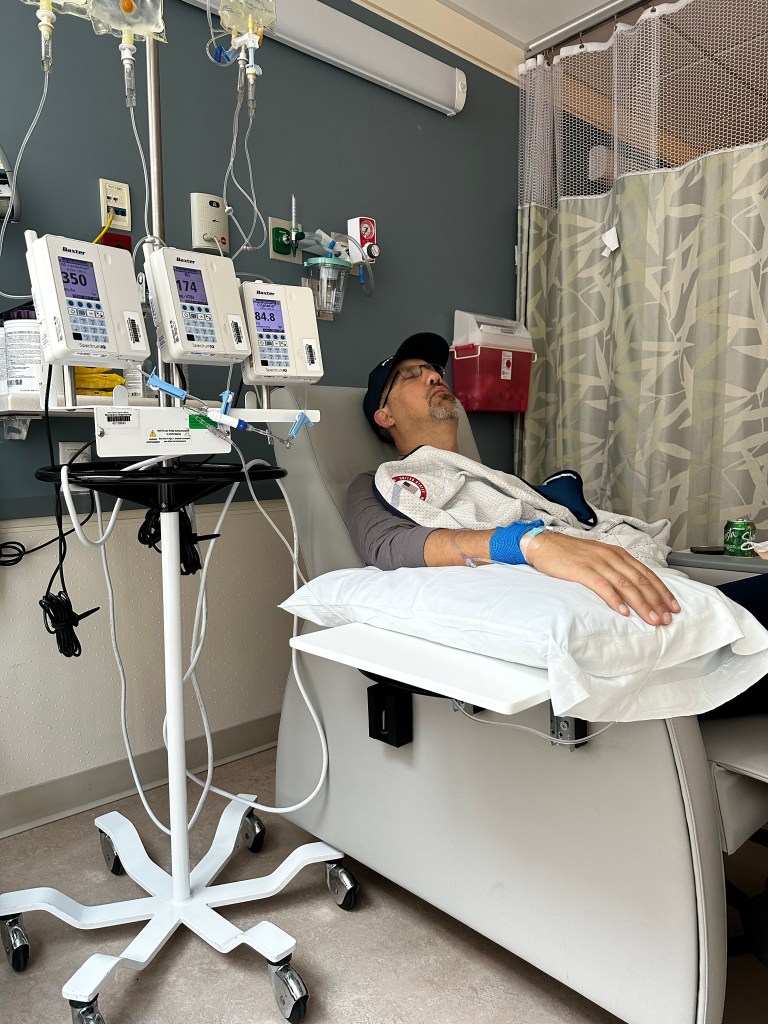
So did you get all that? Quiz tomorrow at 9am. Don’t be late. Fact is the infusions were painless. I did fall asleep for a bit and I think I woke the entire infusion ward when I snored myself awake. Of course Aimee caught a photo.
I did get one other super interesting treatment that I hinted at earlier. The drug is called Neulasta. Neulasta (pegfilgrastim) is a prescription medicine used to help reduce the chance of infection due to a low white blood cell count, in people with certain types of cancer , who receive chemotherapy that can cause fever and low white blood cell count. Originally I was supposed to self inject on day three but they offered me an auto-injectible pod that is placed on my arm and then automatically injects the required does 27 hours after placement. I love f(@#@#! Science!!! The nurse placed it on my arm and after three minutes it started to beep and spool a small plastic cannula that is then injected into the fatty part of my arm (not that i have any fat on this finely ripped 50 year old specimen, ha!). Once the cannula is placed it retracts the needle and 27 hours later it injects, and 30 minutes after that its done and you can remove the pod. So cool! It felt like a little rubber band snapping against my arm. This is a real important drug because the chemo kills so many white blood cells that I am much more at risk for infection. So much so that if I get a 100.4 temp I need to get admitted to the hospital. The only side effect from this one is apparently severe bone pain, oh joy!

Finally got to leave around 3pm. I will admit the rest of the day hasn’t been so hot. Bad migraine, some indigestion, and just some general discomfort but also not real bad and something I could definitely deal with especially given the alternative of not doing is suboptimal. Now I am going to go force myself to eat some oatmeal and continue to hydrate. I really don’t want to eat and drink but that’s really not an option if I want to stay out of the hospital.
Anyway, I may not feel 100% but I chose to make today a great day, and it was, and I hope yours was too!
 Driving to a Cure
Leave a comment